You know those things that are true? That you are supposed to remember?
(This is me, at around age 7, talking to my mom.)
Mom: Ummm, honey, do you mean “facts?”
Me: Yes! I don’t like those.
Apparently, during a teacher’s lesson on “facts” versus “opinions,” I had a happy little epiphany that my preferences fell neatly into one category. It was called “opinions.” And now that it was so clear I thought: Finally! The grownups have figured out what the boring stuff is. Obviously they will stop talking to me about it now.
That day my mother was kind enough to spare me from the truth: adults would continue to think that their facts were more important than my opinions. She also didn’t tell me that while I was glibly discovering an aversion to data, doors were slamming closed on entire categories of careers, like anything to do with math, history, or science. I guess she thought that I would figure that out in my own time, and she was right.
The rest of my course through school was predictable. I was curious and engaged, but often missed the point of my teachers’ lessons. I didn’t learn to multiply until two years after everyone else had moved on to algebra. I couldn’t explain the differences between the branches of the government, or even name them. And I had no idea what the periodic table of elements was, or why it was hanging in every science classroom since it certainly wasn’t an aesthetically pleasing decoration.
Facts and data underpin these subjects like rocks in a riverbed. Opinion, fiction, and creativity are secondary, and that was a problem for my ego. It was, in all honesty, a control issue. So naturally, I excelled in areas like art and creative writing; games which I always won because I could invent the rules according to my own interests. Since elementary school, my attitude towards factual information has improved considerably, but even as an adult my interaction with facts and data is pretty minimal. I was an art kid who grew up to become an artist.
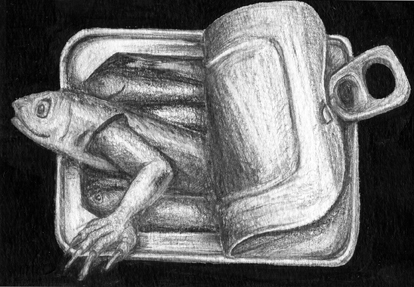
Over the past year, I’ve created a couple drawings as gifts for friends who are also artists. This was an intimidating prospect, and I worked through a lot of ideas. In the end I felt compelled to invent hybrid creatures for them, and the weinercorn and the fizzard were born.
It’s hard to bring new life into the world, especially when your children aren’t beautiful babies, but misshapen creatures. These were my first animal drawings since I was in elementary school, when I used to draw pencil portraits of our mutt, Sidney. Creating the weinercorn and the fizzard made me feel like something that I never thought that I would be: a scientist. Not a reasonable and systematic scientist, but more like one of the Victor Frankenstein’s distant cousins.
Society fears the “mad scientist.” The mad scientists like Victor Frankenstein and the guys in Jurassic Park are dangerous because they understand nature’s laws but like artists, they don’t play by someone else’s rules. It is probably for the best that I don’t understand animal husbandry enough to actually create animal hybrids, but sometimes we all need the right “spirit animal” to connect with us. And sometimes that animal is a crossbreed. Through drawing, I am able to give this gift to my friends.
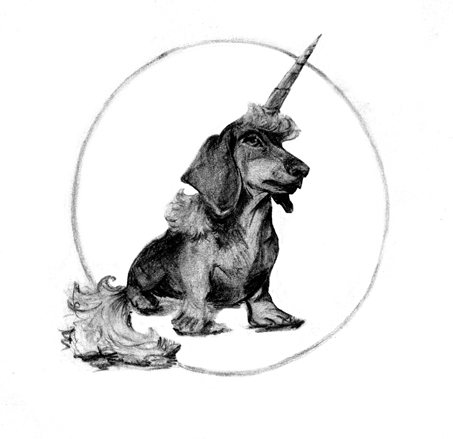
The Weinercorn is for my friends Emily Smidt and Lou Bunk, who are getting married next month. Emily loves dachshunds and Lou loves unicorns. I think that these loves reveals something about their respective natures. Like a dachshund, Emily is grounded, playful, determined, and generally adorable. And Lou is not unlike a unicorn. Lou looks for the magic in every day, and he is a composer of minimal, yet complicated music that is like the unicorn, grounded and ethereal in equal measure. The Weinercorn is meant to be a symbol of their union.

The Fizzard was a gift for my friend Mike Piechocinski , who is retiring this year after several years teaching in Montgomery County’s magnet art program, the Visual Art Center. He is a wonderful and dedicated teacher, but when I picture him, ironically, I think about him at lunch. He would preside over elaborate salads with a scrap of canvas tucked into his shirt as a sort of a makeshift bib. It was always a good reminder that we need to stake out moments for ourselves, no matter how busy things get. The meals often involved oily cans of fish, a smell that will always make me think of Mike (and I mean that in the best possible way.) So I wanted to draw this can of fish for Mike, but after I started the drawing I realized that Mike could not be contained. Mike has big energy, and big ideas, and so the fish grew a lizard-like claw to help it climb out of his can.
 themuddypalette
Your description of Lou and Emily is spot on. I had never made that connection with Lou and his unicorns, but he really does find magic in every day.
You’re more of a scientist than you think. Trust me, takes one to know one. xo
You Are awesome! And wow do I love your wonder!!!! Xxoo
Kristin,
I really enjoy your writing. You are amazing and so talented (and I not just saying that because you are my cousin)! I have always admired creative minds. Minds unlike mine which is more “fact” based.
I’m glad we have people with different types of minds in the world and in our family, and I am very glad that I didn’t tell my seven year old child that her creativity and imagination would limit her career choices! It’s better to find a career (and a life) that fits your true self than it is to try to “madly squeeze a right-hand foot into a left-hand shoe” (to quote Lewis Carroll.)
Rather than taking you away from a career path, it sounds like your preferences led you to what you are really supposed to be doing. And without that, we would never have the glorious creature known as the Weinercorn! Wonderful work.